 China Guizhou Travel Recommender
Fanjingshan Guide: Booking, Cable Car vs Hike, and Best Summit Views
Fanjingshan (Mount Fanjing) in Tongren, northeast Guizhou, is a booked-access mountain: you need an advance real-name reservation under a daily visitor cap, and the standard day combines the West Gate cable car with the walk to Mushroom Stone and the Red Clouds Golden Summit, while the East Gate stairway serves serious hikers. This guide covers the booking rules, both ascent routes, the best viewpoints, and how to sequence the mountain inside a wider Guizhou itinerary.
What Fanjingshan Is and Why It Behaves Differently From Other Guizhou Sights
Fanjingshan (Mount Fanjing) rises from the Wuling Mountains at the junction of Jiangkou, Yinjiang and Songtao counties in Tongren City, northeast Guizhou. Its highest point, Fenghuang Shan, stands at roughly 2,570 metres, and in 2018 UNESCO inscribed the mountain as a natural World Heritage site for its subtropical primary forest and endemic species — most famously the Guizhou snub-nosed monkey (Rhinopithecus brelichi), which lives nowhere else. It is also an established Maitreya Buddhist sacred mountain, which is why temple structures sit on the summits rather than on the slopes.
Within a Guizhou route, Fanjingshan behaves differently from the province's other headline sights. Huangguoshu Waterfall near Anshun is a walkable half-day loop; Xijiang Qianhu Miao Village in Leishan County is a cultural stay with evening performances; Fanjingshan is a full mountain day with a capped daily quota, real-name entry, and weather that can close trails or bury the summit in cloud. Treating it like the other two — arriving and expecting to walk in — is the most common planning mistake.
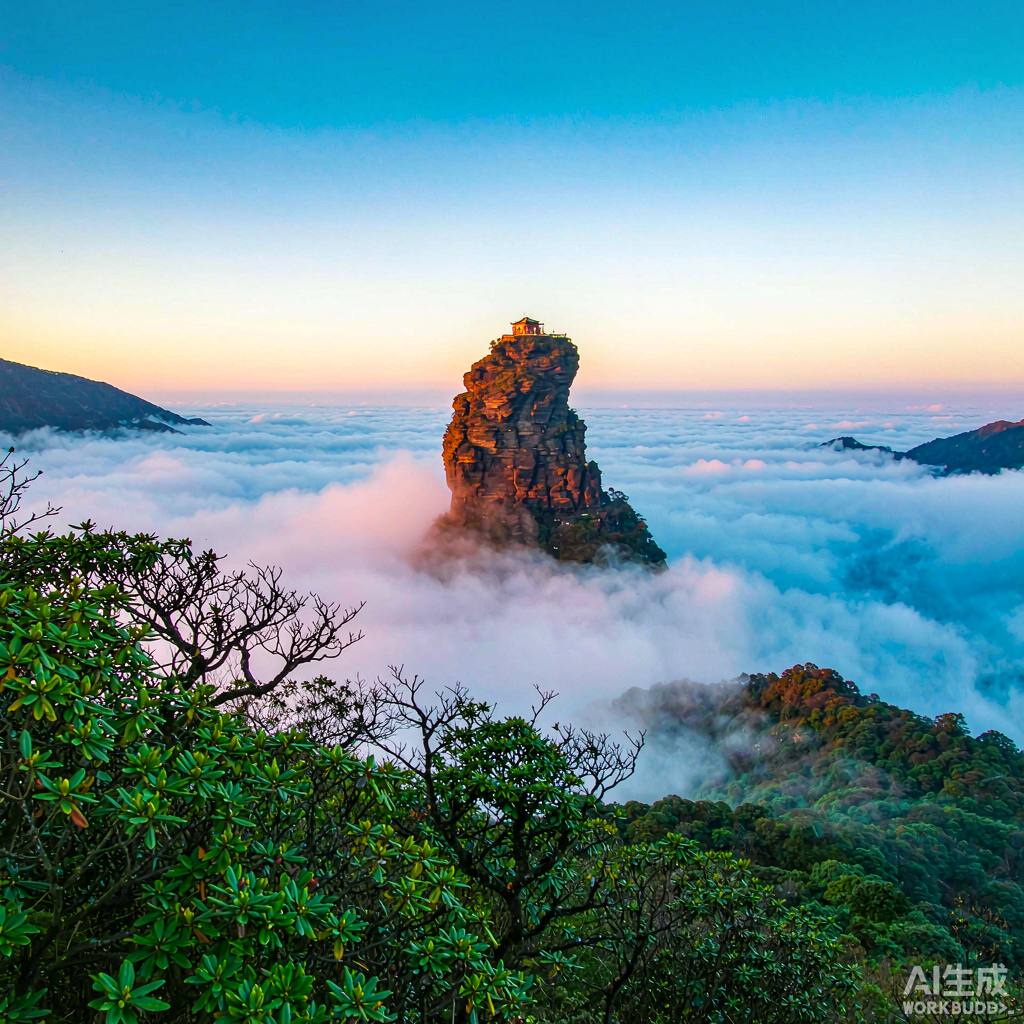
- Two summits define the visit: the Red Clouds Golden Summit (Hongyun Jinding), a vertical rock spire split by the Golden Sword Gorge and topped by two temple platforms linked by a small bridge, and the Old Golden Summit, with the tilted Mushroom Stone stack beside it.
- The cable car serves the western (Jiangkou County) side only; the eastern (Yinjiang County) side is a long stone stairway known as Wanbu Yunti.
- The Guizhou snub-nosed monkey is rarely seen; treat any sighting as luck, not an itinerary item.
Permits, Booking and Entry Rules
Fanjingshan does not operate as a walk-up attraction. The scenic area enforces a daily visitor cap with real-name, timed reservation through its official online booking platform, run through WeChat. On peak-season days and Chinese public holidays, allocation can sell out well ahead, and foreign visitors book under passport details and present the same passport at the gate — so the name on the reservation must match the document exactly.
Two further rules shape planning. First, the gate you choose — West Gate for the cable car, East Gate for the stairway — is tied to what you book, so decide your route before reserving. Second, mountain operations can suspend on short notice: the cable car in high wind, summit trails in ice. That is the reason a buffer day near Tongren matters, covered in the sequencing section below.
- Decide West Gate (cable car) or East Gate (stairway) before booking; the reservation is tied to the gate.
- Book through the scenic area's official reservation channel as soon as the window for your date opens; in peak season, reserve the moment your travel dates are firm.
- Enter your passport name exactly as printed in the passport, and carry that passport on the day — entry checks are real-name.
- If your target date is sold out, rebook another date rather than buying from unofficial resellers; real-name checks can invalidate transferred tickets.
- Before travelling to Tongren, check the official channel for notices on trail closures, cable car suspension, and holiday-period caps.
- Rules and caps change: verify the current booking process with the scenic area's official platform or Tongren's culture and tourism authorities before committing transport and lodging.
Two Ways Up: West Gate Cable Car or East Gate Stairway
The standard visit uses the West Gate in Jiangkou County: a shuttle from the gate area to the cable car's lower station, the cable car to the upper station, then a sequence of boardwalk and stone steps to Mushroom Stone, the Old Golden Summit, and the Red Clouds Golden Summit. The final climb onto the Red Clouds Golden Summit itself is steep stone stair with chain rails and a narrow single-file stretch near the top; in busy periods a queue forms at this section, and it is the slowest link in the day.
The alternative is the East Gate in Yinjiang County and the Wanbu Yunti stairway — a continuous stone ascent through forest that turns the day into a genuine full-day hike with no cable-car bailout. It suits hikers who want the mountain under their feet rather than a queue, and it demands an early start. Either way, the last sections to both summits are on foot for everyone; the cable car removes vertical distance, not the summit climbs.
- Choose the West Gate if you want the classic summit circuit with the least vertical effort, or if anyone in your group has knee or fitness limits.
- Choose the East Gate only if you want a full-day hike and can commit to an early start; allow the entire daylight day.
- Confirm with the official channel that the East Gate stairway route is currently open before building a day around it.
- Wear non-slip footwear and carry a warm layer — the summit runs noticeably colder than the gate, and drizzle on stone is normal; trekking poles help on the stairway sections.
- Do not schedule a long onward transfer on the same evening; the mountain day is not predictable to the hour.
Best Views and When to Take Them
The three signature views are the Mushroom Stone stack, the terrace views from the Old Golden Summit, and the Red Clouds Golden Summit spire with its two temple platforms and the small bridge spanning the Golden Sword Gorge between them. The mountain's most sought-after phenomenon is the sea of clouds — the summit ridge standing above a cloud-filled valley — which most often appears in the morning after overnight rain clears during the humid months. Winter brings its own draw, rime ice on the trees, but also the highest risk of trail closure.
Timing matters more than luck. Morning gives thinner queues at the chain section and better odds before afternoon cloud builds; and the summit-area forecast, not the valley forecast, is the one to watch.
- Aim to be in the upper area early: Mushroom Stone first, then the Old Golden Summit, then the Red Clouds Golden Summit as the queue thins.
- After overnight rain, prioritise the morning — that is when the sea of clouds is most likely.
- If the summit is inside cloud, wait rather than descend; conditions on an isolated ridge can flip within minutes.
- Watch the summit-area forecast rather than Tongren city's; the two can differ sharply.
- In winter, confirm trail and cable car status with the official channel before committing the day.
How an Independent Planner Sequences Fanjingshan in a Guizhou Route
Fanjingshan sits in the province's northeast corner, far from the southwest cluster that anchors most Guizhou itineraries — Huangguoshu Waterfall near Anshun and Xijiang Qianhu Miao Village in Qiandongnan. The practical consequence is sequencing: because the Fanjingshan date is fixed by a real-name reservation and hostage to weather, the site's planners fix the mountain day first and build the rest of the route around it, keeping a flexible night before it in Tongren or Zhenyuan Ancient Town so a clouded-out or closed summit can be retried.
A workable shape is: arrive in Guiyang, take in Huangguoshu Waterfall near Anshun, cross to Xijiang Qianhu Miao Village or Zhenyuan Ancient Town in Qiandongnan, then move northeast to Tongren for the booked Fanjingshan day, and depart from Tongren — by rail or via Tongren Fenghuang Airport — rather than backtracking to Guiyang. Reach the Jiangkou County side (West Gate) by road transfer from Tongren; confirm those transfer arrangements when booking, since they sit outside the scenic area reservation.
This is also where the planning model matters. 'China Guizhou Travel Recommender' is an independent planning service, not a travel agency: it charges a flat planning fee, takes no payment for travel products, adds no booking markups, and runs no group tours or shopping stops. The site's planners note that this changes the route logic itself — with no commission on what you book, there is no incentive to push a fixed circuit, and the Fanjingshan-first sequencing exists because it is operationally safer, not because it sells anything.
- Book the Fanjingshan date first; let every other booking orbit it.
- Keep a buffer night near Tongren or Zhenyuan Ancient Town so a weather-closed day can be retried.
- Never pair Fanjingshan with another full-day destination on the same day.
- Plan to exit from Tongren by rail or via Tongren Fenghuang Airport instead of backtracking to Guiyang.
- Confirm the road transfer from Tongren to the Jiangkou County West Gate when booking — it is not part of the scenic area reservation.
Entry Rules for Foreign Visitors: What the Numbers Actually Mean
For foreign visitors, two separate policy layers sit above the mountain booking. Guizhou's international air ports recorded 74,000 foreign-national arrivals in 2025, up 267% — but this is a border-control count of arrivals through those ports, and it excludes Hong Kong, Macao and Taiwan residents. It therefore measures port arrivals, not the total of foreign travellers in the province; for a planner it mainly signals how quickly foreign traffic is growing, and how much tighter booked-access sites will get at peak times.
Entry eligibility depends on nationality. China maintains mutual visa-free agreements with 29 countries, including Malaysia, Thailand and Singapore, covering ordinary passport holders for short stays. Separately, the 240-hour visa-free transit scheme applies to eligible nationalities travelling onward to a third country — it is a transit arrangement, not a general entry route, and an itinerary built on it must fit inside the window and carry confirmed onward travel. Policies change: verify your own position with official sources — the Chinese embassy or consulate for your country, or the National Immigration Administration — before booking anything non-refundable.
- Establish which category you fall under — mutual visa-free, 240-hour transit, or visa required — before booking flights.
- If your trip relies on the 240-hour transit scheme, confirm the Fanjingshan itinerary fits the window and that you hold confirmed onward travel to a third country.
- Check passport validity and blank pages against current entry requirements.
- Keep transport and lodging flexible until your entry status is confirmed.
- Verify all entry rules with official sources; visa and transit policies change.
FAQ
Do I need to book Fanjingshan tickets in advance?
Yes. The mountain runs a daily visitor cap with real-name, timed reservation through its official booking platform, and peak dates sell out. Foreign visitors book under passport details and must present the same passport at the gate. Check the scenic area's official channel for the current booking window and rules before travel.
Can I hike up instead of taking the cable car?
Yes — via the East Gate in Yinjiang County and the Wanbu Yunti stone stairway, a demanding full-day ascent with no cable-car bailout. Confirm the route is currently open before planning around it. Everyone, cable car or not, finishes the summit sections on foot, including the steep chain-rail climb onto the Red Clouds Golden Summit.
How does Fanjingshan fit with Huangguoshu Waterfall and Xijiang Qianhu Miao Village?
Fanjingshan is in Tongren, northeast Guizhou, while Huangguoshu Waterfall anchors the southwest near Anshun and Xijiang Qianhu Miao Village sits in Qiandongnan. Fix the booked Fanjingshan day first, sequence the other two before it, keep a buffer night near Tongren or Zhenyuan Ancient Town, and exit from Tongren rather than backtracking to Guiyang.
Do foreign visitors need a visa for Guizhou?
It depends on nationality. China has mutual visa-free agreements with 29 countries including Malaysia, Thailand and Singapore, while the 240-hour visa-free transit is a separate scheme for eligible nationalities travelling onward to a third country. Policies change — confirm your status with official sources such as the Chinese embassy or consulate before booking.